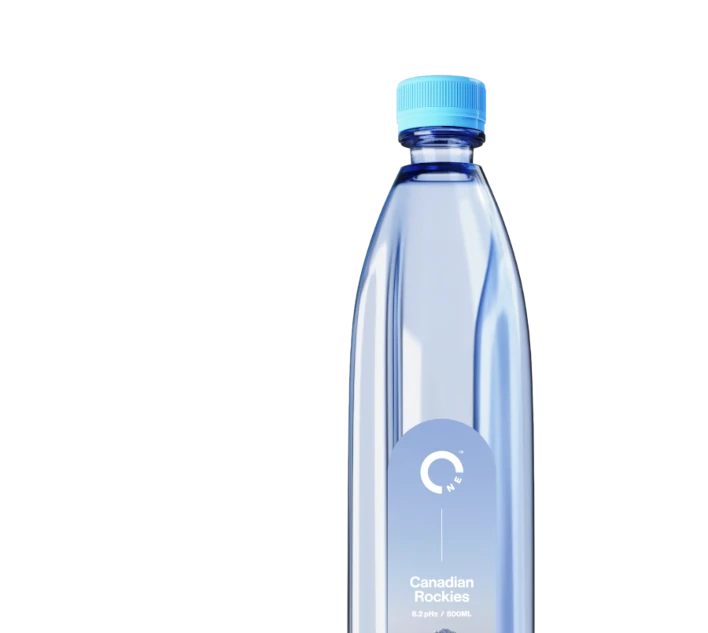
At One Water, innovation doesn’t stop at what’s inside the bottle — it extends to how that bottle moves through the world.
Our team set out to create a design that delivers purity and performance while reshaping how bottled water is transported. And the result? A patented snap-to-stack bottle that’s earned the Zenith Global Best Innovative Technology Award.
Here’s how this award-winning design helps reduce shipping emissions by up to 35% without sacrificing strength, design, or taste.
Why Shipping Emissions Matter More Than Most People Realize
When people think about the carbon footprint of bottled water, they often picture plastic production or recycling, and not the trucks that carry bottles across the country.
Yet freight transport can account for 35–50% of a product’s total carbon footprint in the beverage industry.
Shipping emissions refer to the CO₂ released by trucks, ships, and planes moving goods. Every ton of freight moved one mile produces roughly 161 grams of CO₂, according to data from the Environmental Defense Fund.
Multiply that across thousands of miles and millions of bottles, and it’s easy to see how logistics quickly add up.
Some of the factors that drive those emissions include:
- Long-haul trucking across regional distribution hubs
- Empty pallets returning to suppliers
- Packaging inefficiencies that waste valuable truck space
Reducing that footprint is truly an engineering challenge. And that’s exactly where we set out to create an innovative product.
The Design That Makes the Difference
Traditional water bottles are limited by geometry. Their rounded bases and gaps between cases waste space on pallets, forcing companies to ship fewer bottles per load.
One Water’s snap-to-stack bottle solves that with an interlocking, nestable design that locks into place like precision-built architecture.
How the design transforms shipping efficiency:
- Bottles stack securely, minimizing wasted airspace
- Pallets are more stable with no slipping or shifting
- Lightweight structure without added material
- More bottles per truckload, fewer trips overall
The Math Behind Lower Shipping Emissions
Innovation doesn’t end with design — it’s proven in the results. The numbers behind One Water’s packaging efficiency tell a measurable story of sustainability, showing how intelligent engineering translates to real-world environmental benefits.
By improving how bottles stack, we significantly increase the number that can be shipped in a single load while maintaining structural integrity.
Let’s look at how that math breaks down in real-world logistics.
Industry Average vs. One Water: Real Pallet Data
To understand the difference, you need to compare One Water’s 500 mL bottles to the standard 16.9 oz (500 mL) industry format. By comparing pallet efficiency, it’s easier to see how packaging innovation reduces freight emissions across every shipment.
Typical Industry Pallet (500 mL):
- ~72 cases per pallet, 24 bottles per case = 1,728 bottles
- Average pallet weight ≈ 1 ton (2,200 lb)
One Water Pallet (500 mL):
- 160 cases per pallet, 20 bottles per case = 3,200 bottles
- Total pallet weight ≈ 1.9 tons (3,800 lb)
To break it down further, our snap-to-stack bottles fit 85% more bottles per pallet, and weigh around 7% less per bottle.
What this really means for logistics and sustainability:
- Increased truckload capacity: more bottles per truck means fewer total shipments
- Reduced wasted airspace: maximized volume efficiency with each pallet
- Lower total freight costs and emissions: fuel and carbon output decrease proportionally
How the Difference in Bottles Per Pallet Affects Truck Shipments
Because we fit more bottles on a pallet, we need fewer pallets and fewer trucks to deliver the same volume.
For every 32,000 bottles shipped:
- Competitors require 18.5 pallets
- One Water requires 10 pallets
That’s roughly 45% fewer pallets and 35–40% fewer truck trips (and around 35% lower emissions) for the same amount of product delivered.
Using the EDF average of 161 grams of CO₂ per ton-mile, our higher packaging density means that we save tens of thousands of kilograms of CO₂ each year, depending on distance and delivery volume.
The Ripple Effect: Efficiency Across the Supply Chain
Logistics efficiency doesn’t just lower emissions. It makes operations cleaner, leaner, and more cost-effective across the entire supply chain.
Every layer benefits:
- Suppliers: Move more product with fewer trucks, saving fuel and labor
- Retailers: Stock more inventory per delivery, reducing handling costs
- Consumers: Choose a brand that delivers environmental integrity without compromise
Even within warehouses, fewer pallets mean fewer forklift runs, less shrink-wrap, and more available floor space.
What began as an eco-minded innovation has become a system-wide improvement in sustainability and supply-chain performance.
Redefining Sustainable Design at One Water
Sustainability goes beyond what a product is made out of to incorporate how it moves, performs, and impacts the world around it.
By rethinking something as simple as how bottles stack, we’ve proven that environmental progress doesn’t have to come at the cost of design or experience.
Discover the purity of innovation — find One Water near you today.